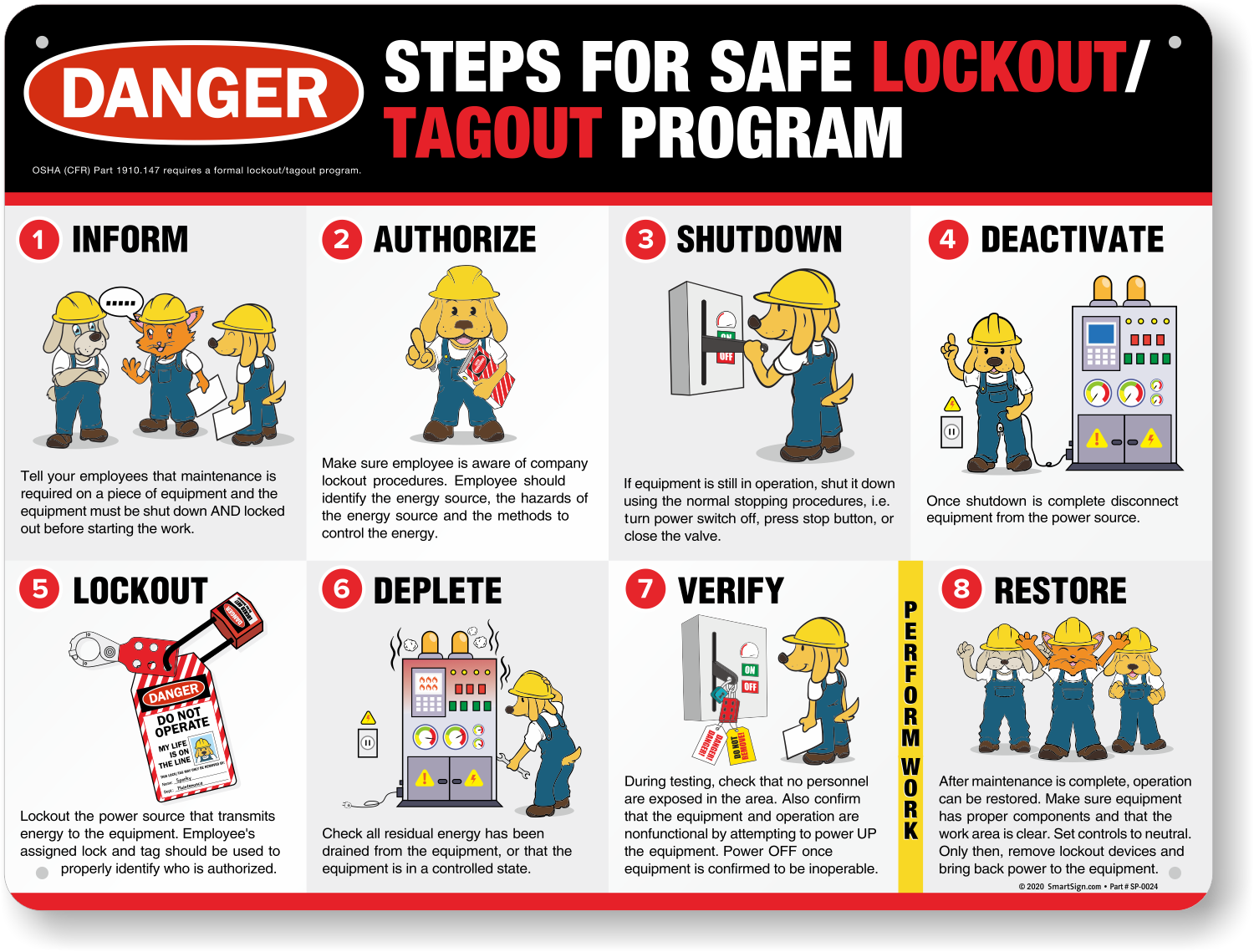
A machine shuts down for maintenance. A technician reaches in. Nearby, someone unaware hits a start button. Seconds later, tragedy strikes. This scenario — preventable, yet recurring — underscores why lockout tagout signs exist. They aren’t just labels on a cabinet; they’re the first verbal intervention in a high-risk chain of events. When properly used, lockout tagout signs stop confusion, enforce accountability, and visually declare: This equipment is not safe. Do not operate.
While locks physically stop energy release, signs communicate intent. They bridge the gap between action and awareness. In this guide, we break down the real-world function, regulatory backbone, and strategic deployment of lockout tagout signs — because in industrial safety, clarity saves lives.
Why Lockout Tagout Signs Are Non-Negotiable
Lockout tagout (LOTO) isn’t just a protocol — it’s a legally mandated system under OSHA 29 CFR 1910.147. At its core, it requires the isolation of hazardous energy sources during servicing or maintenance. Locks secure energy-isolating devices; tags communicate the reason, status, and responsible party.
But tags alone aren’t enough. In high-noise, high-traffic environments, visual signs act as force multipliers. They provide:
- Immediate recognition from a distance
- Universal understanding across language barriers
- Legal defensibility during audits or investigations
- Behavioral cues that influence habit and compliance
Without signs, LOTO becomes invisible. A worker may not see a lock, misinterpret a tag, or assume maintenance is complete. A clear, prominent sign turns passive protection into active warning.
Types of Lockout Tagout Signs and Where to Use Them
Not all signs serve the same purpose. Deploying generic labels undermines their credibility. Purpose-built signs match specific hazards, equipment, and workflows.
1. Equipment-Specific Lockout Signs
These identify the exact machine or system under lockout. Example: “LOCKOUT IN PROGRESS – CNC MILL #3 – J. SMITH – 8:15 AM.”
Best for: Manufacturing lines, industrial machinery, automated systems. Tip: Pair with color-coded tags. Red for electrical, yellow for mechanical, etc.
2. Group Lockout Warning Signs Used during multi-craft maintenance. A central sign lists all workers involved and their locks on a hasp.
Example: “GROUP LOCKOUT IN PROGRESS – 4 TECHS ENGAGED – SEE LOG BELOW.” Critical for: Refineries, power plants, complex assembly systems.
3. Blank LOTO Tags and Signs Reusable or write-once labels for dynamic environments. Must resist moisture, grease, and abrasion.
Use case: Mobile maintenance crews, facilities with rotating equipment. Warning: Faded handwriting or smudged text defeats the purpose. Use bold, permanent markers.
4. Multilingual Lockout Signs In diverse workplaces, signs in Spanish, Vietnamese, or Tagalog prevent miscommunication.
Real-world impact: A 2019 incident in Ohio was avoided when a Spanish-speaking operator spotted a tag he could read. Compliance note: OSHA doesn’t mandate multilingual signs — but it does require understanding. If workers don’t comprehend the message, the system fails.
5. “Do Not Operate” and “Danger – Equipment Under Maintenance” Standardized phrases recognized across industries. These are your baseline — mandatory, not optional.
OSHA Requirements: What the Law Says About LOTO Signs
OSHA doesn’t just recommend signs — it demands them. Key requirements under 1910.147(d)(5) and (e)(3) include:

- Tags must be durable enough to withstand the environment (60-day minimum life).
- Tags must contain a warning (e.g., “DANGER – DO NOT OPERATE”).
- Tags must list the name of the authorized employee applying the lockout.
- Tags must be affixed near the lockout device, clearly visible.
Common violations that get cited: - Using paper tags in wet or oily environments - Missing employee names - Tags placed where they’re easily missed - Reusing damaged or faded signs
Fines can exceed $15,000 per violation. More importantly, non-compliance puts lives at risk. One missed sign, one ignored tag — that’s all it takes.
Best Practices for Placement and Visibility
A sign no one sees is as good as no sign at all. Strategic placement isn’t guesswork — it’s risk engineering.
Critical Placement Zones
- At the energy-isolating device: Circuit breaker, valve, disconnect switch.
- On machine control panels: Where operators initiate cycles.
- Near access points: Entry doors to electrical rooms or mechanical pits.
- On lockout stations: Centralized LOTO cabinets with master logs.
Design Rules That Work
- Contrast is king: Red/white or yellow/black for maximum visibility.
- Minimal text: Use icons (e.g., lightning bolt, hand in gear) alongside words.
- Size matters: At least 7” x 5” for most applications; larger for outdoor or distant viewing.
- Weather resistance: Vinyl or laminated polyester for harsh conditions.
Real mistake: A plant in Michigan placed LOTO signs behind a control panel. During an audit, the OSHA officer opened the panel — too late. The sign was hidden, and the citation followed.
Common Mistakes That Undermine LOTO Sign Effectiveness
Even facilities with signs in place often fall into traps that erode safety culture.
1. Treating Tags as Formalities Some workers fill out tags but don’t secure them properly. A dangling tag on a zip tie? Useless. It must be affixed to the lock or hasp, where removal requires intent.
2. Allowing Blank or Incomplete Tags “Unknown” or “Tech” instead of a real name? That’s a compliance failure. Accountability requires identity.
3. Using Generic, One-Size-Fits-All Signs A sign that says “Maintenance in Progress” on a boiler, lathe, and conveyor blurs urgency. Be specific: “HIGH-PRESSURE STEAM SYSTEM LOCKED OUT – DO NOT OPEN.”
4. Poor Training on Sign Interpretation Workers must know not just to see signs, but to stop when they do. New hires, contractors, and temporary staff need hands-on LOTO training — not just a video.
5. Failing to Audit Sign Use Without regular checks, LOTO drift becomes normal. Monthly audits should include: - Are signs legible? - Are they placed correctly? - Are locks and tags removed after service?
One refinery reduced LOTO incidents by 68% after implementing quarterly sign audits.
Top 5 Lockout Tagout Sign Suppliers and Their Strengths
Choosing the right supplier means balancing durability, customization, and compliance.

| Supplier | Key Strength | Best For | Compliance Ready? |
|---|---|---|---|
| Brady Corporation | Industrial-grade materials, multilingual options | Heavy manufacturing, energy | Yes |
| Grainger | Wide in-stock availability, fast shipping | SMBs, quick replacements | Yes |
| Seton | Custom printing, bulk ordering | Facilities with unique workflows | Yes |
| PK Safety | Eco-friendly options, PPE bundles | Green-focused operations | Yes |
| SafetySign.com | Low-cost standard signs, OSHA templates | Small workshops, training labs | Yes |
Pro tip: Order sample packs before bulk buying. Test for adhesion, UV resistance, and smudge-proof ink in your actual environment.
Real-World Use Cases: How LOTO Signs Prevent Disasters
Case 1: Automotive Assembly Plant (Detroit) A robotic arm needed calibration. Two technicians locked out the cell, tagged the main disconnect, and placed glowing “ROBOT CELL LOCKED OUT – DO NOT ENTER” signs. A third worker, rushing to meet a deadline, approached the panel — then stopped. The sign gave him pause. He verified the lockout log. Incident avoided.
Lesson: Signs create cognitive friction. That pause is safety in action.
Case 2: Food Processing Facility (California) A conveyor jam required clearing. The maintenance tech applied a lock and tag. But the sign was small and placed low. A supervisor restarted the line, thinking the issue was resolved. The machine activated — the technician had just pulled his arm out.
Aftermath: The facility upgraded to large, overhead-mounted signs with flashing LED borders. Zero recurrences in 3+ years.
Integrate Signs Into a Complete LOTO Workflow
Lockout tagout signs aren’t standalone. They’re part of a six-step sequence:
- Preparation: Identify energy sources and required procedures.
- Notification: Alert affected employees.
- Shutdown: Turn off equipment using normal controls.
- Isolation: Disconnect energy (valves, breakers).
- Lockout & Tagging: Apply locks and clear, visible signs.
- Verification: Test for zero energy — try to start the machine.
Signs appear at steps 2, 5, and throughout verification. They’re not an afterthought — they’re woven into the rhythm of the process.
Act Now: Make Your LOTO Signs Impossible to Ignore
Your lockout tagout signs should be unmissable, unambiguous, and unremovable without intent. Audit your current setup today. Are signs weatherproof? Are names filled in? Are they placed where operators must see them?
Replace faded labels. Train contractors. Use multilingual options if needed. And never treat a sign as paperwork. It’s a lifeline — the first sentence in a story that ends with someone going home safe.
Do it right. Do it now.
Frequently Asked Questions
What makes a lockout tagout sign OSHA-compliant? It must be durable, legible, include a warning (e.g., “Danger – Do Not Operate”), and list the authorized employee’s name.
Can I use digital signs or displays for LOTO? Not as primary tags. OSHA requires physical tags that remain in place even during power loss.
Do lockout signs need to include the time of lockout? Not required by OSHA, but best practice. Adding time helps track duration and accountability.
Should LOTO signs be red? Red is strongly recommended for “Danger” signs. Yellow is acceptable for “Caution” — but red signals higher severity.
Can one sign cover multiple machines? Only if they’re part of a single energy control procedure. Otherwise, each machine needs its own tag and sign.
What material is best for outdoor LOTO signs? Use UV-resistant vinyl or aluminum with industrial laminate to prevent fading and corrosion.
Are bilingual LOTO signs required? Only if workers don’t understand English. The message must be understood by all affected employees.
FAQ
What should you look for in Lockout Tagout Signs: Your First Line of Defense? Focus on relevance, practical value, and how well the solution matches real user intent.
Is Lockout Tagout Signs: Your First Line of Defense suitable for beginners? That depends on the workflow, but a clear step-by-step approach usually makes it easier to start.
How do you compare options around Lockout Tagout Signs: Your First Line of Defense? Compare features, trust signals, limitations, pricing, and ease of implementation.
What mistakes should you avoid? Avoid generic choices, weak validation, and decisions based only on marketing claims.
What is the next best step? Shortlist the most relevant options, validate them quickly, and refine from real-world results.